
Strength training in perimenopause: why lifting heavier protects your bones
What changes in your bones around menopause, what research says about lifting weights, and how to start safely.

By Team NXT LVLThe NXT LVL coaching team
5 min read
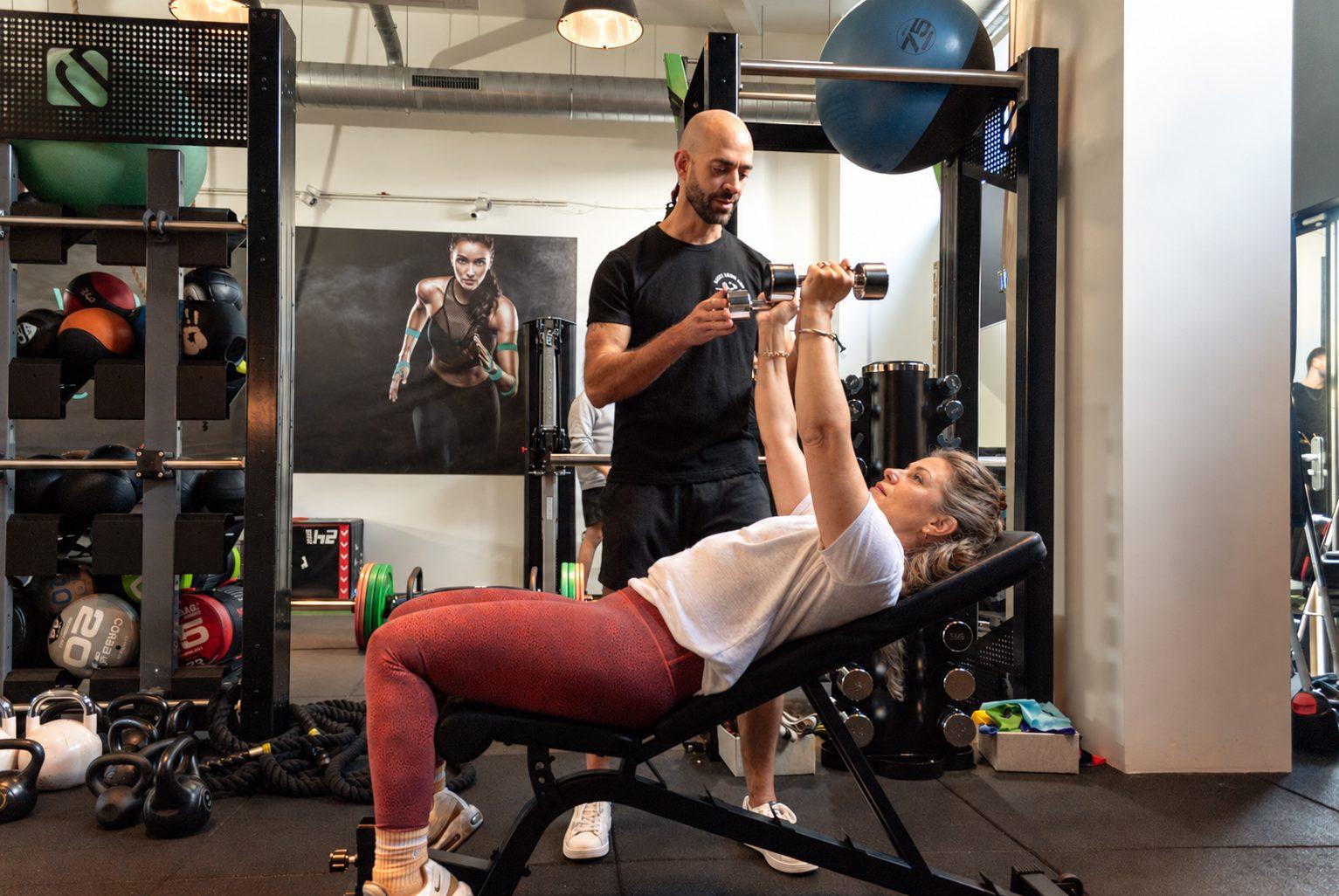
"I don't want to lift heavy. I just want to stay toned."
If we had a euro for every time we heard this from a woman in her forties or fifties, we could outfit the entire studio with new kettlebells. We completely understand where it comes from. If you grew up in the era of step aerobics, 1-kilo pink dumbbells, and constant magazine warnings about getting "bulky," picking up a heavy weight feels counterintuitive, maybe even reckless.
But here is the truth we share on the gym floor: picking up a challenging weight can help you build strength and muscle. We can tailor the training to your goals and adjust it as your body changes. More importantly, if we are talking about protecting your skeleton during perimenopause, lifting heavier weights is one of the most effective things you can do.
Here is what is actually happening to your bones, and why it is never too late to get stronger, improve your body composition, and feel amazing in your own skin.
The silent shift in your bone density
Around menopause, your body's protective estrogen levels drop, fundamentally changing how your bones rebuild themselves. The SWAN study, which tracked thousands of women, pinpointed a critical window starting roughly a year before your final menstrual period and lasting about three years. During this fast-loss phase, bone density declines by about 2% a year on average, with greater declines in the spine than the hip. Loss continues more slowly afterwards; over ten years, the cumulative decline is around 10%.
The International Osteoporosis Foundation estimates that one in three women over 50 will eventually experience a fracture related to osteoporosis. Dutch guidelines (like Thuisarts) rightly recommend daily movement, calcium, and Vitamin D. Brisk walking is useful weight-bearing activity. Progressive resistance training adds a different loading stimulus and can complement it; the right combination depends on your starting point and health.
Bones only adapt when they are challenged by load.
The study that changed how we view fragile bones
If you think lifting heavy is dangerous for older bones, look at the groundbreaking LIFTMOR trial published in 2018. The researchers took 101 postmenopausal women, averaging 65 years old and all with low bone mass, and had them do the unthinkable.
Under strict supervision, these women didn't do gentle chair exercises. They built up to heavy squats, deadlifts and overhead presses at more than 85% of their maximum, plus jumping chin-ups. It completely shattered the myth that women with low bone density need to be treated like fragile glass.
The trial enrolled 101 women and assigned 49 to supervised resistance and impact training and 52 to a lower-intensity home programme. After eight months, the training group's average spine bone density rose by 2.9%, while the control group's fell by 1.2%. No fractures were reported; one minor lower-back spasm occurred. These results in screened postmenopausal women do not establish that every reader can train without injury or will obtain the same benefit.
You do not copy this program at full intensity on day one.
The reality of training through perimenopause
We know that perimenopause isn't just about silent bone loss. You might walk into the studio running on four hours of broken sleep, dealing with hot flushes, or feeling unusually stiff in your joints.
At NXT LVL, our philosophy is rooted in patience and flexibility. We never force a heavy session on a bad day. If you arrive exhausted, we pivot. We treat it as a "deload" day, adding much more mobility work, dropping the weights, and modifying movements so they fit exactly how you feel in that moment. We aim for sessions that feel manageable and leave you confident.
Many women are intimidated the first time they stand over a kettlebell to learn a proper deadlift. But by the time the hour is up, that intimidation often turns into an incredible sense of accomplishment.
The perfect pair: Strength and Reformer Pilates
At our Amstelveen studio, we combine Coached Strength training (maximum 5 people) with Reformer Pilates (maximum 6 people). We view them as the ultimate complementary pair.
Reformer Pilates builds full-body strength with a profound focus on flexibility, posture, and deep core stability, helping you move with more confidence. Strength training delivers the heavier, axial loading your bones need to stay dense. While some of our members love sticking strictly to Pilates, many combine both to get the benefits of heavy lifting alongside the deep core control of the Reformer.
We also track your body composition with Visbody 3D scans every four weeks in our Longevity programmes. While the scan doesn't measure bone density (ask your GP for a DEXA scan for that), seeing how your muscle and body composition change over time can be a powerful motivator.
A practical way to begin this week
If your GP gives you the green light, you can start building this habit on your own:
- Two full-body strength sessions a week, with at least one rest day in between.
- The movements: A goblet squat, a Romanian deadlift (with dumbbells or a kettlebell), a one-arm dumbbell row, and an overhead press.
- The rep scheme: Start with 2 sets of 8 to 12 repetitions per exercise. Choose a weight where you feel you have 2 or 3 good reps left in the tank. Build to 3 sets.
- The balance finisher: End with 30 seconds of single-leg balance on each side, standing near a wall for safety.
- The focus: Nail your technique, particularly the hip hinge (pushing your hips back while keeping your spine neutral).
Ready to build your confidence?
You can start on your own, but if you want an expert eye to help you practise technique and choose appropriate loads, with a program that flexes with your energy levels, we are here to guide you.
Explore our two introductory routes:
- Intro Group Training: Experience our small-group coaching and Reformer Pilates.
- Intro Personal Training: Get one-to-one guidance perfectly tailored to your starting point, physical condition, and schedule.
Check out our introductory options and pricing on our Start Here page, or book a free 45-minute intake in Amstelveen to discuss your goals. It is never too late to get stronger.

Written by
Team NXT LVL
The coaching team at NXT LVL Personal Training in Amstelveen.